
In a competitive market, building a recognisable brand requires more than an attractive logo or a well-designed website. Businesses need creative ways to connect with their audience, increase brand visibility and create a lasting impression. One effective option is custom caps that combine practical everyday use with distinctive branding.
Custom caps have become a popular choice for businesses, fashion labels, sports teams, charities, event organisers and promotional campaigns. They offer a useful accessory that people can wear at work, during outdoor activities, at events or as part of their everyday outfits. When designed thoughtfully, a cap can become more than a simple piece of headwear. It can represent your brand wherever it goes.
At Custom Embroidered Caps UK, we understand the importance of creating branded headwear that reflects a business’s identity, style and purpose. From choosing the right cap style to selecting colours, embroidery and finishing details, every decision contributes to the final result.
Whether you are launching a clothing brand, updating staff uniforms or preparing merchandise for an upcoming event, this complete guide explains how to create custom caps that make your brand stand out.
1. Why Custom Caps Are an Effective Branding Tool
Brand recognition develops when people repeatedly see and interact with a business. While online advertising, social media and traditional marketing have their place, physical branded products offer another way to keep your business visible.
Custom caps provide a combination of practicality, style and brand exposure. Unlike promotional materials that are often discarded after a short period, a comfortable, well-designed cap may become part of someone’s regular wardrobe.
Here are several reasons businesses choose custom caps for branding.
Increased Brand Visibility
A cap featuring your company logo can introduce your brand to people who may never have visited your website or encountered your advertising. Employees can wear branded caps during working hours, customers can wear them in public, and event participants can take them home as useful merchandise.
The visibility of your logo depends on the cap’s design, placement and how frequently it is worn. A clear, recognisable logo can help people remember your business over time.
A Professional and Consistent Appearance
Businesses that use branded uniforms often want their teams to look coordinated and professional. Custom caps can complement workwear, polo shirts, jackets and other uniform items.
For example, a landscaping company might choose dark green caps with a contrasting embroidered logo, while a construction business might prefer practical caps in colours that match its existing uniforms.
Consistent colours and logo placement help create a unified appearance across different teams and locations.
A Useful Promotional Product
Promotional merchandise works best when people have a reason to keep using it. Caps offer practical benefits, including shade from sunlight and an easy way to complete a casual outfit.
For this reason, custom caps can be suitable for exhibitions, sporting events, product launches, charity fundraisers and customer appreciation campaigns.
Rather than treating a cap as an ordinary giveaway, businesses can design it as a product that recipients genuinely want to wear.
Opportunities for Additional Revenue
Fashion brands, creators and independent businesses can also use custom caps as part of their product collections.
A carefully designed cap can complement hoodies, T-shirts, jackets and accessories. Limited-edition colourways, distinctive embroidery and thoughtful finishing details can help a cap feel like a considered retail product rather than generic merchandise.
2. Choosing the Right Custom Cap Style for Your Brand
The style of cap you select influences its appearance, comfort and suitability for your target audience. Before deciding on embroidery or colours, consider who will wear the caps and where they will be used.
Custom Baseball Caps
Baseball caps are one of the most versatile choices for branded headwear. Their familiar shape makes them suitable for corporate uniforms, promotional campaigns, sports clubs and fashion merchandise.
They commonly feature a curved peak, an adjustable fastening and a front panel suitable for displaying a logo.
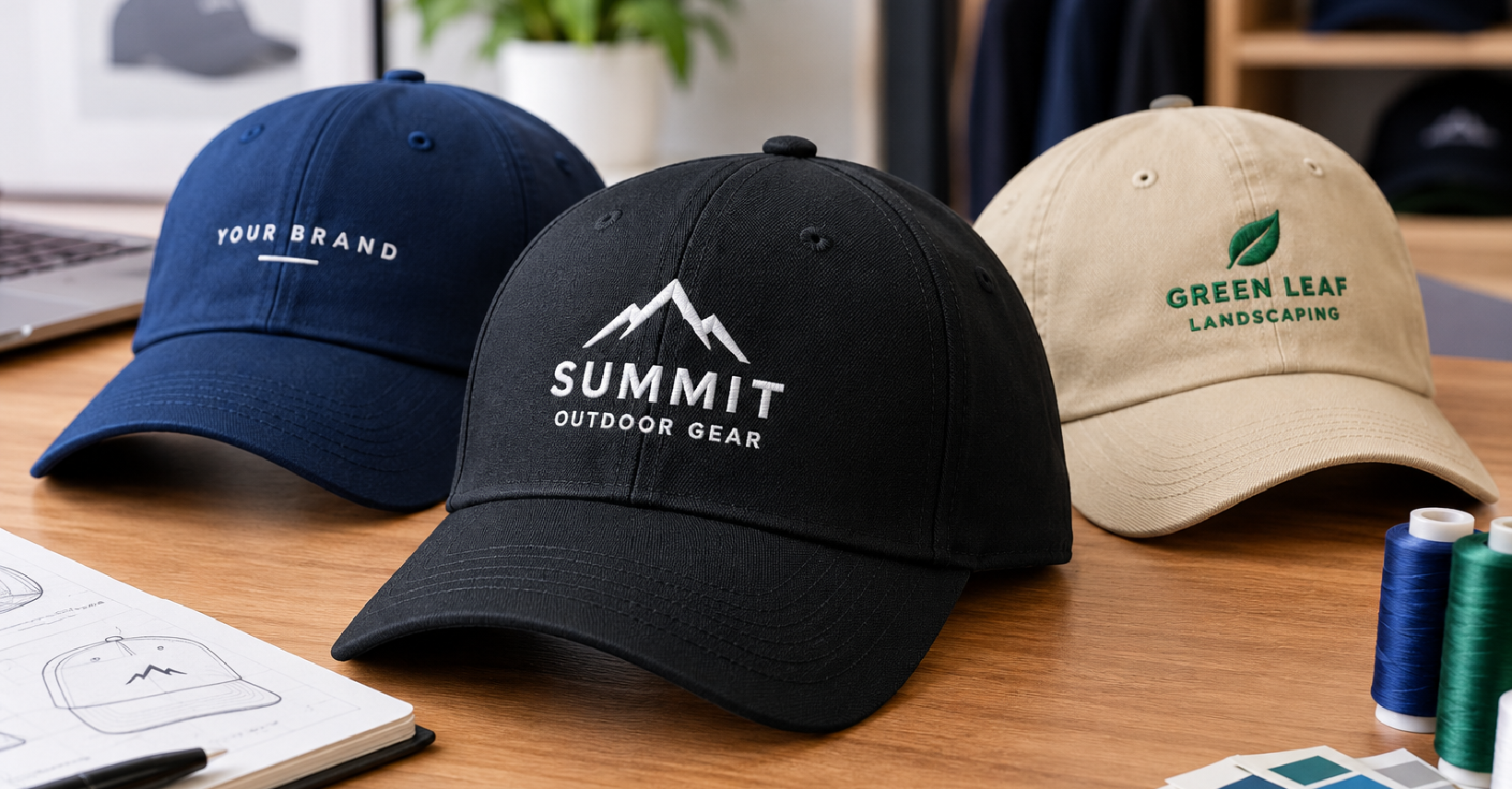
For a professional business look, consider a navy, black or charcoal baseball cap with contrasting embroidery. For a more relaxed retail collection, brighter colours or minimalist designs may be more appropriate.
Custom Trucker Caps
Trucker caps typically combine a structured front panel with breathable mesh panels at the back. This construction gives them a distinctive appearance and makes them an appealing option for casual clothing brands, outdoor businesses and lifestyle merchandise.
A trucker cap can work particularly well when a brand wants a bold front logo, a vintage-inspired design or a combination of contrasting colours.
For example, a cream front panel paired with a dark green mesh back and matching embroidery can create a distinctive look without making the design unnecessarily complicated.
Custom Snapback Caps
Snapback caps generally feature a flat or relatively flat peak, a structured crown and an adjustable snap fastening.
They are popular with streetwear labels, music merchandise brands, sports-inspired collections and businesses targeting younger audiences.
Their structured front panels can work well with bold lettering, geometric symbols and 3D puff embroidery. The overall design should reflect your brand personality rather than simply following current fashion trends.
Custom Dad Caps
Dad caps typically have a relaxed shape, an unstructured crown and a curved peak. They suit businesses that prefer a subtle, casual or understated aesthetic.
Small embroidered logos, initials and simple wordmarks often complement this style particularly well.
A minimalist design on a washed-effect cap can be an attractive option for lifestyle brands, independent creators and businesses developing premium casual merchandise.
Five-Panel and Six-Panel Caps
The panel construction affects the cap’s silhouette and the space available for branding.
A five-panel cap often has a broad front section that can suit certain graphic designs and streetwear styles. A traditional six-panel cap usually has a central seam at the front and a familiar baseball-cap appearance.
Neither option is automatically better for every brand. The best choice depends on the artwork, desired fit and overall design.
When planning your order, consider the front panel’s shape before finalising your logo dimensions.
3. Why Custom Embroidered Caps Create a Premium Look
Decoration is one of the most important decisions when designing branded headwear. Although printing can suit some graphics, embroidery remains a popular choice for businesses that want a textured and professional finish.
Custom embroidery uses thread to stitch a design directly into the cap’s fabric. This creates a tactile appearance that can give a logo greater depth and visual interest.
Durability for Regular Use
A well-produced embroidered logo can withstand regular wear better than many surface-applied graphics. Its longevity still depends on the thread, stitching, cap fabric, construction and care instructions.
For staff uniforms, promotional merchandise and everyday retail products, durability is an important consideration because the cap should continue representing your brand after repeated use.
A Distinctive Appearance
Embroidery adds texture that is visible and noticeable at close range. This can help a simple logo look more substantial without requiring additional graphics or complicated artwork.
For example, a clothing brand might use white embroidery on a black cap for a clean, high-contrast appearance. Another brand might select tonal stitching for a more understated finish.
The right approach depends on whether your brand aims to look bold, refined, sporty or casual.
Flat Embroidery
Flat embroidery is a traditional technique in which thread sits relatively close to the fabric’s surface.
It is suitable for many logos, symbols, lettering and detailed designs when the artwork is appropriate for the available stitching area.
This option works particularly well for company logos, staff uniforms, club branding and caps intended for everyday use.
Three-Dimensional Puff Embroidery
3D puff embroidery uses a foam layer beneath the stitching to create a raised effect.
It is often chosen for bold lettering, initials and simple graphic elements on structured caps. The extra height can make a design more prominent and give it a distinctive streetwear or premium sportswear appearance.
However, not every logo is suitable for this technique. Thin lines, tiny text and intricate details may not stitch cleanly over foam.
Embroidered Patches
Embroidered patches provide another way to display a brand identity. A patch can have a defined border and a distinct shape, making it useful for logos designed as badges or crests.
Patches can suit outdoor brands, sports clubs, workwear collections and fashion labels that want a different visual treatment from direct embroidery.
The most appropriate decoration method depends on your design, cap material, budget and desired finish.
4. How to Design a Logo That Looks Great on a Cap
A logo that looks excellent on a computer screen may need adjustments before it can be embroidered onto a small, curved surface.
Embroidery has practical limitations because thread cannot reproduce every fine line, gradient or tiny detail in the same way as a digital image.
Planning for these limitations early can help you achieve a better result.
Keep the Main Design Recognisable
Start by identifying the most important part of your logo. It might be a symbol, a distinctive letter, a short wordmark or a combination of these elements.
Avoid overcrowding the front panel with too many separate details. A clean design can be easier to recognise from a distance and may translate more effectively into embroidery.
If your original logo includes a long slogan or small supporting text, consider using a simplified version for the cap.
Choose an Appropriate Logo Size
Logo size affects the overall balance of the design.
A logo that is too large may dominate the cap, while one that is too small may be difficult to recognise. The ideal dimensions depend on the cap style, panel shape and artwork.
Ask your manufacturer to consider the usable embroidery area and how the logo will sit on the actual cap. A digital mock-up can help you assess the proportions before production.
Select Readable Typography
Text-heavy designs require particular attention. Thin lettering, tightly spaced characters and decorative fonts can become difficult to read when converted into stitches.
Bold, well-spaced typography is often a practical choice for cap embroidery.
If your brand name is long, consider using a shorter wordmark on the front and reserving secondary text for the side or back panel.
Simplify Fine Details Where Necessary
Simplification does not mean losing your brand identity. It means adapting the artwork to suit the manufacturing method.
For example, tiny decorative lines might be removed, closely spaced letters might be separated, or a complicated illustration might be reduced to its most recognisable features.
A good design brief should preserve the important elements of your brand while allowing enough flexibility to achieve clean stitching.
5. Choosing Colours That Reflect Your Brand Identity
Colour influences how people perceive your business and how easily they recognise your logo.
When designing custom caps, consider the relationship between the cap fabric, embroidery thread and your existing brand colours.
Use Contrast to Improve Visibility
Contrast helps a logo stand out against the cap.
Popular combinations include:
- Black caps with white or gold embroidery.
- Navy caps with white or light grey stitching.
- Cream caps with dark green or black embroidery.
- Forest green caps with gold or cream logos.
- Burgundy caps with white or tonal embroidery.
These combinations are starting points rather than fixed rules. Your own brand colours should guide the final decision.
Match Your Existing Brand Colours
Consistency matters when custom caps are part of a wider marketing strategy.
If your website, packaging and clothing use particular shades, try to maintain a similar colour palette across your headwear.
Keep in mind that a colour displayed on a monitor may look different from the final fabric or embroidery thread. Where colour accuracy is important, discuss suitable thread and material references with your manufacturer.
Consider Tonal Branding
Tonal branding uses similar shades for the cap and logo, such as black embroidery on a black cap or dark navy thread on navy fabric.
This creates a subtle appearance that can work well for premium clothing brands and minimalist designs.
Although tonal embroidery can look sophisticated, ensure there is enough contrast for the logo to remain visible under different lighting conditions.
Think Beyond the Front Panel
The peak, button, eyelets, mesh panels and fastening can all influence the overall appearance.
Using a matching peak or contrasting mesh can add character without making the main logo more complicated.
The key is to choose details that support the brand rather than compete with it.
6. Selecting the Right Fabric and Construction
The fabric and construction of a cap affect comfort, shape, appearance and suitability for different environments.
A cap designed for a retail fashion collection may have different requirements from one intended for outdoor staff or sports activities.
Cotton and Cotton Twill
Cotton and cotton-twill fabrics are popular for casual and everyday headwear.
They can offer a traditional appearance and work well with many embroidered logos. Their suitability depends on the specific fabric weight, weave and cap construction.
These materials are worth considering for company merchandise, lifestyle brands and classic baseball caps.
Polyester and Performance Fabrics
Polyester and performance-oriented fabrics can be useful for active environments, particularly where lightweight construction and moisture management are priorities.
They may suit sports clubs, outdoor teams and businesses whose employees spend considerable time outside.
Before choosing a performance fabric, consider the intended activity, breathability, comfort and care requirements.
Mesh Panels
Mesh-backed caps are often selected for their distinctive appearance and ventilation.
They are popular for promotional products, outdoor businesses, casual brands and trucker-style headwear.
When selecting a mesh cap, pay attention to the front panel’s structure because it influences how the embroidered design will sit.
Structured and Unstructured Crowns
A structured cap contains additional support in the front panels to help the crown maintain its shape.
An unstructured cap usually has a softer, more relaxed appearance.
Structured caps can provide a stable surface for bold embroidery, while unstructured styles may suit smaller logos and understated branding.
Neither construction is universally superior. Choose according to the intended style and how you want the cap to look when worn.
7. Where Should Your Logo Go on a Custom Cap?
Logo placement affects both visibility and visual balance. The best position depends on your artwork, cap style and branding objectives.
Front-Centre Embroidery
The front centre is the most familiar position for a cap logo.
It works well for primary brand marks, club crests, business names and prominent symbols. If your design is intended to be recognised quickly, this is usually a sensible starting point.
On six-panel caps, the central seam may influence the available space and the way certain designs are stitched.
Side-Panel Branding
Side embroidery can add a secondary branding detail without crowding the front.
You might use a small symbol, initials, a short slogan or a collection name. This approach can work particularly well for fashion merchandise and premium branded caps.
Back-Panel Details
The back panel can accommodate a small wordmark, initials, website address or other secondary design.
For example, a brand could place its main logo at the front and a small symbol above the rear fastening.
Keep the secondary design proportionate so it complements rather than distracts from the main branding.
Multiple Logo Placements
Some businesses choose embroidery on the front and one additional position on the side or back.
This can create a more considered product, particularly for retail collections. However, every additional placement should serve a purpose.
If the front logo already communicates your identity clearly, a simple secondary detail may be more effective than adding several competing elements.
8. How Custom Caps Can Support Different Types of Businesses
One of the advantages of custom headwear is its versatility. Different industries can adapt the same basic product to suit their audience and brand personality.
Corporate Businesses
Companies can use branded caps for staff uniforms, customer gifts, promotional events and internal activities.
A consistent cap design can complement other branded clothing and help employees present a coordinated appearance.
For a corporate setting, neutral colours and clear embroidery often provide a practical starting point.
Clothing and Streetwear Brands
Fashion businesses can treat custom caps as standalone products rather than simply promotional items.
Design choices such as 3D puff embroidery, distinctive colour combinations, metal buckles and carefully selected fabrics can contribute to a recognisable collection.
For a cohesive range, keep the brand identity consistent while experimenting with different cap styles or colourways.
Sports Clubs and Fitness Businesses
Sports teams, gyms and fitness brands can use custom caps to strengthen team identity and create merchandise for members and supporters.
Choose a comfortable style that suits the intended activity, and consider whether the cap will be used for training, travel, events or everyday wear.
For active use, fit, ventilation and fabric performance deserve as much attention as the logo.
Construction and Outdoor Businesses
Outdoor companies may need headwear that complements practical work clothing.
A durable-looking cap in a suitable colour can help complete a uniform while providing shade during outdoor work.
The design should prioritise clear branding, comfort and suitability for the working environment. Caps should not be treated as substitutes for required protective headwear.
Charities and Fundraising Campaigns
Custom caps can form part of a fundraising campaign, awareness initiative or community event.
A recognisable design can help supporters show their involvement while giving the organisation an additional merchandise option.
For fundraising products, think carefully about the balance between production costs, retail pricing, brand visibility and the audience’s preferences.
Events and Promotional Campaigns
Businesses can create custom caps for exhibitions, festivals, launches and team-building activities.
Using event-specific colours or a limited-edition logo can help distinguish the caps from regular company merchandise.
Before placing an order, confirm the quantity required, distribution arrangements and delivery deadline.
9. Custom Caps for Small Businesses and Growing Brands
A common misconception is that custom headwear only makes sense for large organisations.
In reality, smaller businesses can use branded caps to establish a more consistent identity and introduce their products to new audiences.
The key is to make sensible decisions about design, quantity and intended use.
Start With a Clear Objective
Decide what you want the caps to achieve. Are they for staff uniforms, customer gifts, retail sales or a particular campaign?
Your objective will help determine the appropriate cap style, decoration method and quantity.
For example, a business ordering uniforms may prioritise consistency and comfort, while a streetwear label may focus more heavily on appearance and finishing details.
Plan Your Quantity Carefully
The number of caps you order affects the overall budget and may influence the price per unit.
Larger orders can sometimes reduce the unit cost because certain production and setup expenses are spread across more products. However, the actual price depends on the design, materials, decoration and supplier’s pricing structure.
Consider your expected demand, available storage and distribution plans before deciding on a quantity.
Choose Quality That Matches Your Audience
A cap intended for resale may need different finishing details from a basic event giveaway.
Think about how the product will be used, what your customers expect and how the cap should represent your business.
A well-considered product can support your brand’s reputation more effectively than one chosen on price alone.
10. How to Order Custom Caps With Your Logo
A clear ordering process helps reduce misunderstandings and makes it easier to communicate your requirements to a manufacturer.
At Custom Embroidered Caps UK, prospective customers can begin by identifying their preferred cap style and the branding they want to achieve.
The following steps provide a useful framework for planning your order.
Step 1: Define Your Requirements
Start by deciding how the caps will be used, who will wear them and how many you need.
Make a note of your preferred colours, cap style, closure, embroidery position and any additional design features.
If you have reference images, provide them to help communicate the desired appearance.
Step 2: Prepare Your Logo Artwork
A clear logo file helps the manufacturer understand your design.
Vector formats such as AI, EPS or SVG can be useful when available, while high-resolution PNG files may also help communicate the artwork.
If your logo includes fine details or several colours, ask whether any adjustments are recommended for embroidery.
Step 3: Discuss Materials and Decoration
Confirm your preferred fabric, cap construction and embroidery technique.
If you are unsure which combination is suitable, explain your intended use and desired appearance so that the options can be evaluated.
This is also the time to discuss any secondary logo placements, special fastenings or contrasting design elements.
Step 4: Review the Digital Mock-Up
A digital mock-up provides a visual representation of the proposed cap and logo placement.
Review the proportions, colours, embroidery size and overall balance carefully. Check that the logo matches your supplied artwork and that any requested secondary details are included.
Ask for corrections before authorising production if something does not match your requirements.
Remember that a digital mock-up illustrates the design but cannot reproduce every physical detail of the finished embroidery.
Step 5: Confirm the Quote and Production Details
Before proceeding, make sure you understand the total price, quantity, payment arrangements, estimated production time and delivery terms.
If you have a fixed launch date or event deadline, communicate it clearly at the beginning.
Confirm which design changes can be accommodated and at what stage approval is required.
Step 6: Approve the Final Design
Final approval is an important checkpoint because it confirms the design you expect the manufacturer to produce.
Check the logo artwork, colours, placement, quantities and other agreed specifications before giving authorisation.
Keeping these details documented helps both parties work towards the same result.
Step 7: Plan Delivery and Distribution
Once the production arrangements are confirmed, allow sufficient time for manufacturing, dispatch and transportation.
If the caps are intended for a launch, exhibition or retail release, include a reasonable buffer for unexpected delays.
Early planning is especially important for larger orders or projects with a firm delivery deadline.
11. What Affects the Cost of Custom Caps?
The price of custom caps varies according to several factors. Understanding these elements can help you prepare a realistic budget and compare quotations more effectively.
Order Quantity
The quantity ordered can influence the cost per cap. Some production expenses remain relatively consistent regardless of the number of units, so larger orders may offer better unit pricing.
However, always compare the total cost as well as the individual unit price.
Cap Style and Material
Different cap constructions and fabrics have different costs. Specialised performance materials, premium finishing and particular fastening systems may affect the final quotation.
Choose materials that suit the intended product rather than paying for features your audience does not need.
Embroidery Complexity
A simple logo with a few clear elements may require less embroidery work than an intricate design with numerous details.
The design’s dimensions, stitch requirements and number of placements can all influence the production process.
3D puff embroidery and additional embroidered details may also affect pricing.
Number of Branding Positions
A cap with one front logo is generally simpler to produce than one featuring embroidery on the front, sides and back.
Discuss your priorities with the manufacturer and decide which placements make the greatest contribution to the finished product.
Additional Features
Custom fastenings, special labels, contrasting panels and other finishing details may add to the total cost.
If your budget is limited, prioritise the elements that have the greatest impact on appearance and usability.
12. Common Mistakes to Avoid When Designing Custom Caps
Even a strong brand identity can be undermined by avoidable design decisions. A little planning can make the difference between a balanced, wearable cap and one that does not meet expectations.
Using an overly complicated logo: Too many small details can become difficult to reproduce in thread. Simplify the artwork where necessary while preserving the essential identity.
Choosing colours without enough contrast: A logo can disappear against a similar-coloured cap. Check the relationship between fabric and thread before approving the design.
Ignoring comfort and fit: An attractive cap is less useful if it does not suit the intended wearer. Consider the fastening, crown shape and intended use.
Making the logo too large: An oversized design can dominate the front panel and make the cap look unbalanced. Review the proportions on a mock-up.
Overlooking secondary details: If you want side embroidery, back branding or a particular fastening, include those requirements in the original brief.
Focusing only on price: A low quotation does not necessarily represent the best overall value. Consider the materials, embroidery, construction, communication and delivery arrangements together.
Leaving production until the last minute: A rushed order creates unnecessary pressure. Share your deadline early and allow time for design approval, manufacturing and shipping.
13. Caring for Your Custom Embroidered Caps
Proper care helps preserve the appearance of both the cap and its embroidery.
Always follow the manufacturer’s care instructions, as suitable cleaning methods depend on the fabric, construction and decoration.
Here are some general recommendations.
- Remove loose surface dust with a soft brush or cloth.
- Spot-clean small marks gently with a suitable cleaning solution.
- Avoid harsh chemicals that could affect the fabric or thread.
- Do not assume machine washing is suitable for every cap.
- Allow the cap to air-dry when recommended and avoid excessive heat.
- Store caps in a way that protects their shape and prevents unnecessary pressure on the embroidered design.
For caps used as staff uniforms or retail merchandise, providing basic care guidance can help customers look after the product properly.
14. Why Choose Custom Embroidered Caps UK?
Creating branded headwear involves more than selecting a cap and adding a logo. The most successful results come from bringing the design, materials, construction and intended use together.
At Custom Embroidered Caps UK, our brand is focused on custom embroidered headwear for businesses and organisations looking to develop their own branded caps.
Whether you are exploring ideas for a clothing label, planning corporate merchandise or preparing caps for a promotional campaign, starting with a clear design brief can make the process more straightforward.
Before requesting a quotation, consider the following:
- Your preferred cap style and colour.
- Your logo artwork and desired embroidery placement.
- The quantity you require.
- Any special construction or finishing preferences.
- Your target budget and required delivery date.
Providing these details helps establish the scope of your project and makes it easier to discuss suitable options.
Every brand has different requirements. A simple embroidered logo may be ideal for a business uniform, while a fashion collection may benefit from more distinctive colour combinations and raised embroidery.
The aim is to create headwear that represents your identity, suits your audience and fulfils its intended purpose.
Conclusion
Custom caps that make your brand stand out are the result of thoughtful design, suitable materials and a clear understanding of your audience.
From classic baseball caps and breathable trucker styles to relaxed dad caps and structured snapbacks, there are numerous ways to express your brand through headwear. Embroidery adds texture and a professional appearance, while carefully selected colours and logo placements help create a consistent identity.
The most important decisions are not necessarily the most complicated ones. Choosing a suitable cap, making your logo easy to recognise, confirming the production details and allowing enough time for delivery can all contribute to a better experience.
Whether you need branded uniforms, promotional merchandise, fundraising products or caps for a clothing collection, a well-planned design can help your business present itself consistently and memorably.
Frequently Asked Questions About Custom Caps
1. What are custom caps?
Custom caps are headwear products personalised with a company’s logo, text, artwork, colours or other design details. Businesses use them for uniforms, promotional merchandise, retail collections, events and team branding.
2. Are embroidered caps suitable for business branding?
Yes. Embroidered caps are a popular choice for business branding because stitching creates a textured, professional appearance. They can be used for staff uniforms, customer gifts, corporate events and branded merchandise.
3. Which cap style is best for a clothing brand?
The best style depends on your audience and brand identity. Snapbacks can suit streetwear collections, dad caps can complement relaxed minimalist designs, and baseball caps provide a versatile option for many types of clothing brands.
4. Can I put my company logo on a custom cap?
Yes. Company logos can often be embroidered on the front, side or back of a cap, depending on the design and available space. Your artwork may need minor adjustments to ensure small details remain clear when stitched.
5. Is embroidery better than printing for custom caps?
Embroidery is often preferred for logos because it adds texture and a premium appearance. Printing may be more appropriate for certain complex graphics, gradients or designs that cannot be reproduced effectively with thread. The right method depends on the artwork and intended finish.
6. How do I choose the right colour for branded caps?
Start with your existing brand colours and select a cap shade that provides sufficient contrast with the logo. Consider how the cap will coordinate with uniforms, clothing or other merchandise. Thread and fabric colours should be checked carefully before production.
7. What affects the price of custom embroidered caps?
Pricing can depend on order quantity, cap style, fabric, embroidery complexity, logo size, number of branding positions and additional finishing details. Request a quotation based on your actual specifications for a more accurate comparison.
8. Can custom caps be used as promotional merchandise?
Yes. Custom caps are suitable for exhibitions, product launches, charity events, customer gifts and other promotional activities. Their usefulness and everyday wearability can help keep your brand visible beyond the original event.
9. How can I make my cap logo stand out?
Use a clear design, appropriate logo sizing and contrasting colours. Choose a suitable embroidery technique and avoid overcrowding the available space with tiny text or unnecessary details. A well-balanced design is often more effective than one with too many elements.
10. How far in advance should I order custom caps?
Order well ahead of your intended launch or event date. Production and delivery times vary according to the quantity, design complexity, manufacturer and shipping arrangements. Confirm the expected timeline with your supplier before placing the order.
11. Are custom embroidered caps suitable for small businesses?
Yes. Small businesses can use custom caps to build a consistent visual identity, coordinate staff uniforms or introduce branded merchandise. Choosing a suitable design and ordering an appropriate quantity can help align the project with your budget.